
Introduction to the Curriculum of Women Medical College
MBBS Curriculum Lead Tasks
The MBBS Curriculum Lead, Dr Shomaila, is responsible for the following:
- Curriculum planning, coordination & implementation.
- Coordination with the MBBS faculty members to ensure that the course content aligns with the area of expertise.
- Students are effectively communicated about the course content.
- Bridging between senior management, academic council, faculty & students through HOD
- Assist The HOD in matters related to the curriculum activities of the college in order to improve the standards of Medical Education.
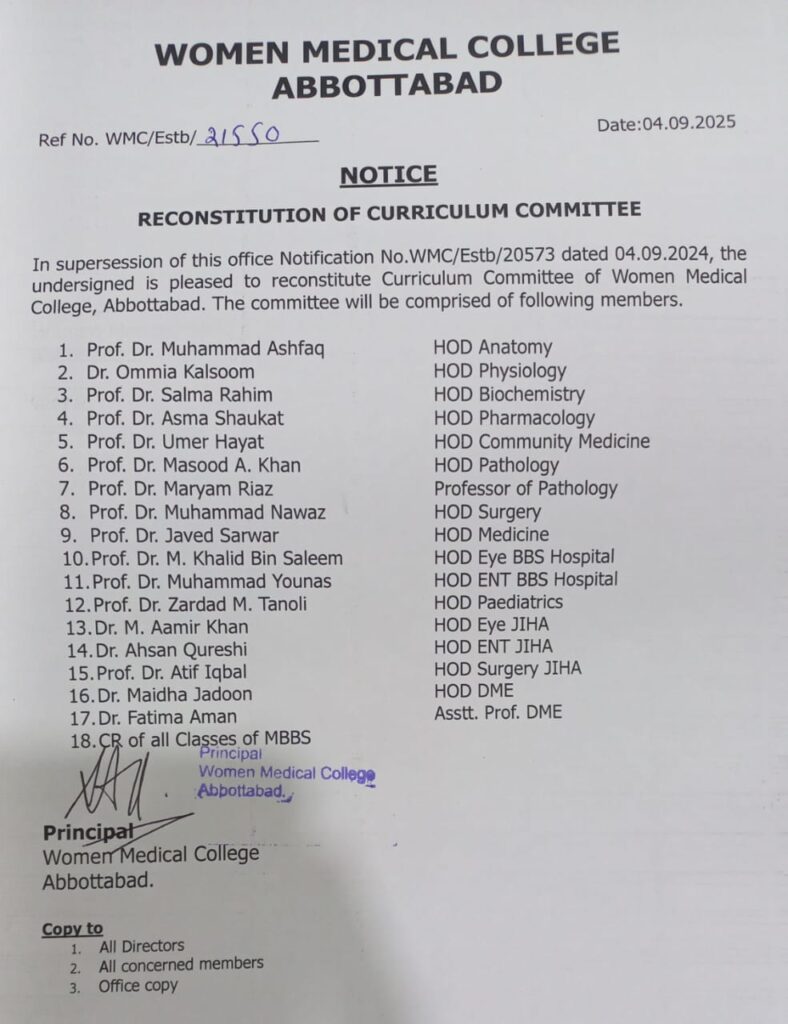
Curriculum Committee Members
Prof. Dr. Muhammad Ashfaq
Dr. Omnia Kalsoom
Prof. Dr. Salma Rahim
Prof. Dr. Asma Shaukat
Prof. Dr. Umer Hayat
Prof. Dr. Masood A. Khan
Prof. Dr. Maryam Riaz
Prof. Dr. Muhammad Nawaz
Prof. Dr. Javed Sarwar
Prof. Dr. M. Khalid Bin Saleem
Prof. Dr. Muhammad Younas
Prof. Dr. Zardad M. Tanoli
Dr. M. Aamir Khan
Dr. Ahsan Qureshi
Prof. Dr. Atif Iqbal
Dr. Maidha Jadoon
Dr. Fatima Aman
CR of all Classes of MBBS
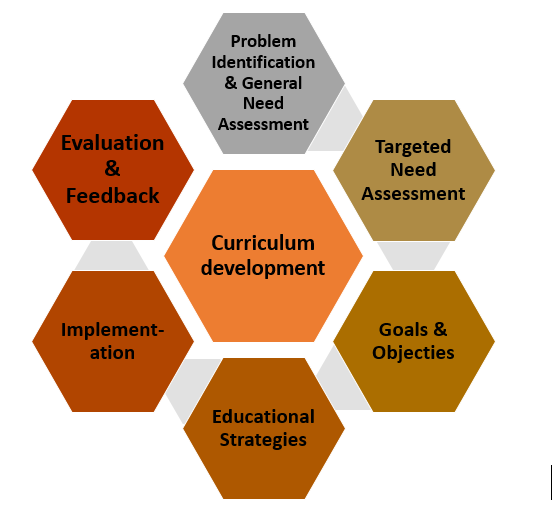
A-Six-Step Approach to Curriculum Development:
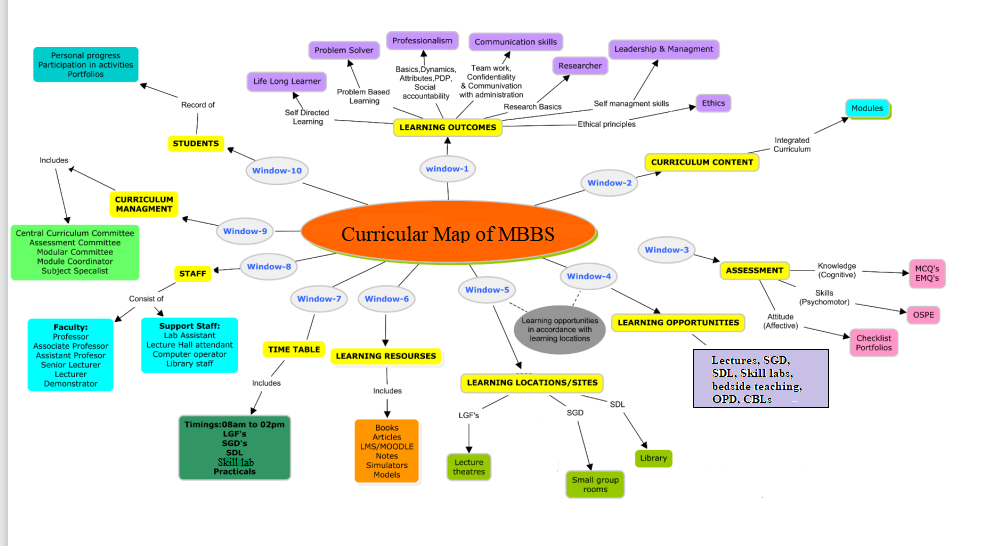
Framework Followed for MBBS Curriculum:
The curriculum is a sophisticated blend of educational strategies, course content, learning outcomes, educational experiences, assessment, the educational environment and the individual student’s learning style, personal timetable and programme of work. The Learning Objectives of the Curriculum are provided by the Curriculum Committee KMU through a Representative of WM&DC. On the basis of these Los, we design our learning and teaching activities that include, Lectures, SGDs, Skills Lab, SDL, PBLs, and Clinical exposure of students. The students are assessed through formative and summative assessments, in which 20% weightage is given to internal exams., and 80% weightage is for professional exams conducted by the university.

Curriculum Design:
The Curriculum of MBBS is designed to produce competent, compassionate, and efficient health professionals. Following the standards of PMC, we try to accomplish the “SEVEN STAR DOCTOR” after the completion of the 5-year Degree; expected generic competencies in a medical graduate are as follows:
1. Skillful
Competent medical graduates require sound clinical skills grounded in knowledge of patient-centred care.
2. Knowledgeable
A medical graduate should be able to:
Differentiate between normal and abnormal structure and functions of the body, molecular, cellular, biochemical, and physiological and pathophysiological mechanisms and processes that maintain and derange homeostasis in health and disease.
Relate the effects and interactions of physical, emotional, and social environments to the health and disease of humans.
Apply Evidence-based medicine concepts to provide the best possible cost-effective care.
Ensure compliance with the legal system, Patient safety guidelines.
3. Community Health Promoter
4. Critical Thinker
The ability to critically evaluate existing knowledge, technology, and information, and to be able to reflect on it, is necessary for solving problems.
5. Professional
Competent medical graduates require professional values, attitudes and behaviors that embody good medical practice that is life-long learning, altruism, empathy, cultural and religious sensitivity, honesty, accountability, probity, ethics, communication skills, and working in teams.
6. Scholar
The medical graduates are expected to demonstrate constructive criticism, a spirit of inquiry, creativity, and a research-oriented attitude.
7. Leader and Role Model
The medical graduates are expected to demonstrate exemplary conduct and leadership potential,
a. Advancing healthcare.
b. Enhancing medical education.
c. Initiating, participating in and adapting to change, using scientific evidence and approaches.
d. Enhancing the trust of the public in the medical and dental profession by being exceptional role models at work and also when away.
e. Accepting leadership roles if required.
f. Providing leadership in issues concerning society
(PMC, 2021)
Curricular Map of MBBS
Dr. Shomaila
Profile
Medical Education & Research,
Planning and Development of Medical Curriculum for MBBS students
Qualification
B.D.S (Pak),
M.H.P.E (candidate) from Khyber Medical University.
Skills and Expertise
Academic System Strengthening, Working and accomplishing standard setups by regulatory bodies of Pakistan, Lead of MBBS Curriculum WM&DC, Student management.